Pages

Showing posts with label industry. Show all posts

October 9, 2018

PGA Tour Set Up, Bunker consistency and Fall Maintenance

PGA Tour Set Up


I had the great pleasure of helping out on the maintenance crew at Silverado last week for the PGA Tour's Safeway Open. Working for former Sonoma Golf Club Superintendent Mat Dunmeyer is always a treat and last week was no different. I especially enjoyed seeing old friends and making new ones from all around the turf industry. My job assignment for the week was Back 9 bunker crew and I wanted to share an "inside the ropes" view of PGA Tour bunker preparations.
The vast majority of course preparations are spent in the weeks and months leading up to the event. Once tournament week arrives, the course is expected to be prepped and ready so the crew can get out and perform routine course set up without skipping a beat. When we arrived early in the week it was obvious the staff at Silverado had done well to meet their goals. The course was in fantastic condition and more than ready. This was especially true in the bunkers. Edges were crisp. Sand depths perfect. Ready for the big show. Then, leave it to Mother Nature and her ability to change even the best of plans. Rain fell Tuesday and while totals were low, it was enough to wet the bunkers and change conditions somewhat. Thankfully the rain let up early in the week leading to sun and perfect Napa weather. By the weekend, winds had picked up resulting in very dry bunker conditions and lots of debris clean up. My point here is...
The bunkers were prepared perfectly throughout the week and yet still, perfect consistency day to day and bunker to bunker was an impossibility. The preparation of bunkers was consistent each morning. The bunkers looked and played beautifully but conditions differed. A snapshot of reality for the tour and for day to day set up at every golf course. Please take a look at the below article from the USGA on bunker consistency.


Bunker Consistency - FIVE reasons why bunkers are not consistent - by the USGA

Despite the best efforts of any agronomic team, maintaining perfectly consistent playing conditions in every bunker is not possible.
Although golf course maintenance teams may spend more labor hours attending to bunkers than greens, golfers will still find that bunkers are inconsistent. Maintaining totally consistent playing conditions in bunkers is not achievable, nor is it necessarily desirable. Here are five reasons why the playing conditions in bunkers will never be perfectly consistent:

1.    Sand depth – The depth of sand on the bunker floor has a profound impact on playability. If the sand is too shallow, bunkers may be wet and firm. However, too much sand yields soft conditions that increase the probability of buried lies. Inconsistencies in bunker sand depth develop on a daily basis from events such as normal play, raking and wind exposure. The recommended depth for bunker sand is 4-6 inches but varies depending on factors such as the physical characteristics of the sand and the properties of the underlying material.
2.    Sun exposure – Bunkers that receive more sunlight will dry faster and play softer than those that receive less sunlight. For example, east- and southeast-facing bunkers dry faster in the morning than bunkers oriented to the west or the north, causing them to play softer.
3.    Wind exposure – Bunkers facing the predominant wind direction will dry faster and play softer than bunkers that are shielded from the wind or face the opposite direction.
4.    Play volume – Bunkers that receive more play will be softer and less consistent than bunkers with very little play. Why? Golf shots, foot traffic and raking disturb bunker sand and soften conditions.
5.    Irrigation – Many golfers wonder if irrigation systems can be designed to avoid adding water to bunkers. Unfortunately, such a design is impractical due to the shape and strategic location of many bunkers. Uniformly irrigating irregularly shaped playing surfaces such as greens, green surrounds and even fairways often places adjacent bunkers in the line of fire of sprinklers. If bunker sand is shallow, contains fine materials such as fine sand, silt and clay, or has been contaminated with organic matter, bunkers will retain moisture. Wet sand plays firmer than dry sand, so bunkers that receive more irrigation and retain more moisture will likely play firmer than those that are well drained and out of the way of irrigation. In the Southwest, where there is little rain and high water demand during summer, bunkers are often wet and firm due to frequent irrigation.
The bottom line is that golf is an outdoor game with inherent variability. For example, no two lies in the rough are exactly the same and, like it or not, the wind blows on some days while other days are calm. Sometimes the wind even blows from one direction in the morning and the opposite direction in the afternoon. Golfers are encouraged to embrace variability in the bunkers and throughout the golf course as a welcome challenge. Remember the wise words of the late Payne Stewart, "A bad attitude is worse than a bad swing." For additional information on bunker consistency, please review the Green Section Collection, “Managing Bunkers,” or contact a USGA agronomist.
 Fall Maintenance 


This fall our maintenance routine has changed from years past. A sure sign that the work we have accomplished over the years has paid off. Greens were aerated with a solid tine and given a medium amount of sand topdressing. Fairways and approaches were slit-seeded with blend of Fine Fescue seed. Tees were aerated with a deep tine. No cores pulled. Less surface disruption and less impact on play. This work was complete in just over a week despite a few equipment breakdowns and being a bit short on staff. As always we do everything we can to minimize disruption to the membership while performing these important "preventative maintenance" tasks. With the first rains of the season falling last week the greens are growing at a good pace and we should be back in shape come this time next week. 

My hat is off to the staff in the Turf Department for their efforts this season. Their work over the year and especially the last few weeks will ensure a strong finish to 2018 and will no doubt set us up for a fantastic 2019. We hope you enjoy the golf course this fall and we appreciate all the support in doing what is right for the health of the golf course. 


December 1, 2015

Sometimes golf, like life, isn't fair

Great stuff here from our consulting Architect Jim Urbina. The guy knows his stuff and here he gets it spot on. See Jim's take below with 5 Bunker Myths as seen in Links magazine August 2015. 


Architect Jim Urbina says we no longer understand their true purpose

1) Bunkers are there to penalize golfers
Nothing could be further from the truth. The great old-time architects said a hazard isn’t just for punishment but to make the game more interesting. Golfers take bunkers personally: Those of us in the design business see them in the exact opposite way. Robert Hunter wrote, “Without hazards, golf would be a dull sport.”
2) You should be able to advance the ball from a bunker
Why? Sometimes golf, like life, isn’t fair. The original bunkers were totally natural, which meant sometimes it was impossible to move the ball forward from them. We’ve since made our own rules and now demand the ability to hit out of a bunker all the way to the green. But that wasn’t always the original purpose.
3) Maintaining them is important
We spend too much time and money maintaining bunkers. Due to expensive sands and labor costs, what should be among the cheapest parts of a course to maintain are the most expensive. They’re hazards, not gardens, and don’t need to be beautiful let alone neat and tidy.
4) They should not be in the middle of a fairway
If you hit a great shot down the middle and it finds a bunker then it wasn’t a great shot. A hazard is often placed for strategy, and one in the fairway is telling you that’s not the best place for hitting to the green. The game requires thought and skill, and sometimes the right play isn’t the obvious one. Same with bunker placement.
5) What you see is what you get
C.B. Macdonald said it can take years to discover and appreciate the hidden qualities of a bunker. Take the time to study the bunker—where it is, how it’s shaped and looks—over and over again. A good bunker makes you think and, as all the greats said, makes a course more interesting.


June 14, 2015

May Newsletter Article - Drought and Water Use

The following article was included in our Member Newsletter earlier this year. As we move into summer, water will continue to be the discussion and I felt it important to share here as well. Enjoy!


On The Course - Maintaining a Golf Course during Drought

As we all know California is in the midst of a record drought. While we did get some much needed rains early this season, rain totals are well below average for the fourth straight year. Temperatures have also been abnormally high during this period. Since January 1, the average high temperature has been 70 degrees with just 3.4” of rain falling. Last month, Governor Jerry Brown mandated a 25% reduction of the use of potable water. While we are fortunate to have a good supply of Non- Potable water to irrigate the golf course with, we must be responsible and show we can and will do the right thing for the course and environment. Over the years, we have accomplished much in the way of becoming more efficient users of water and we are prepared to maintain the course nicely throughout the drought.
We are constantly looking at ways to be more efficient with our use of water. We evaluate the efficiency of our irrigation system on a daily basis. The course is inspected daily for wet spots or dry spots and irrigation run times are adjusted accordingly. Irrigation leaks are detected and repaired quickly. My goal has always been – NO WET SPOTS! This month, we will be going through sprinkler heads in fairways replacing all nozzles and checking pressure to ensure proper coverage is achieved and water is applied as efficiently as possible.

We’ve used hand held and in-the-ground soil sensor technology to monitor soil moisture levels for years now. The use of these sensors allows us to properly monitor soil moisture and insure that the correct amount of water is applied to a given area of turf. Our in-the-ground soil sensor data can be monitored in real time from our desk top and handheld devices.  

With our on-site weather station, we have the ability to monitor weather data in real time as well. The weather station communicates with our irrigation computer calculating daily ET (evapotranspiration) rates. This information is downloaded to the irrigation computer and used to determine appropriate sprinkler run times insuring we are replacing just the amount of water used by the turf and lost to evaporation (ET).

Over the last five years, we have seeded the tees, approaches and fairways at times of aeration with a drought tolerant Chewings Fine Fescue seed. This turf requires approximately 10% of the water needed by many other cool season grasses. Each year, as our stand of Fine Fescue multiplies, we are able to manage more for the fescue and in turn use less water. There will be times when the weaker grasses stress due to drought conditions and this is part of managing toward the desired turf species.

The use of soil surfactants (wetting agents) is an important part of our agronomic plan. A soil surfactant is a material that allows us be more efficient with our water by helping the soil to better hold on to water applied. Surfactants aid in breaking surface tension of tight soil/turf conditions allowing water to better penetrate into the root zone helping to move water deeper and more evenly. This promotes better rooting of turf and a more healthy soil condition. The Club invested in an injection system last year to deliver these materials onto the course via the irrigation system.

Organic fertilizers are an important part of building healthy soils and healthy soils use water more efficiently. These organic fertilizers make up nearly 70% of all fertilizers applied to the course.
If you are on the golf course during the summer months, you have no doubt seen the staff out hand watering various turf areas. There is no more efficient way to deliver water to the desired location than through hand watering.

We have invested much time, effort and resource into providing a high level of turf condition while being environmentally responsible with our use of water. Many of the above practices were implemented years ago, well before the drought. While these changes to our program have resulted in an improved playability of the golf course, they have also put us in position to better weather the current drought.  The majority of increase in the Golf Maintenance budget over the last few years has been directly related to the practices discussed here and I commend the Club for supporting the golf course in such a way.

The fascination with a wall to wall green golf course in California should have changed years ago.  As a responsible member of the community and the golf industry, we should be doing all we can to limit the amount of water we use, mandate or no mandate. Greens, tees and fairways can and will be kept in top condition but we need to get used to rough and areas out of play becoming more natural, un-irrigated and BROWN. As we move through the summer months, there will be more areas of off color turf and that is OK. It will come back when it rains…

Josh Clevenger - Golf Course Superintendent


June 16, 2013

Happy Father's Day Dad!


Happy Father's Day Pop and Happy Father's Day to all the Dad's out there. My Dad introduced me to the game of golf. He got me me up early in the morning to get in 9 before school. He taught me to leave the course better than I found it and sent me to the car when I got out of line. My Dad is the one person I have to thank for the very rewarding career that I've now gotten myself into. Without his introduction and my resulting love for the game, who knows what I'd be up too!  Father's Day Sunday is indeed a great day. For more reason than one.


Father's Day means US Open Sunday. This year the toughest test in golf lands at Merion Golf Club. A classic gem at less than 115 acres with wild fescue grass areas, roughed-up bunkers and quarry holes. Sound familiar?


As I look across the course at Claremont, I see many similarities to the look found at Merion. The bunkers are wild with minimally maintained fescue grass edges on both properties. Claremont is a charming 18 hole classic laid out on under 100 acres while Merion is a brute set on a small property as well. Both courses ooze character with the select placement of fescue native areas mingling in between lush green fairways and greens. Both very cool tracks with a rich history in the game.


 While the look is similar, it's not the same and for the most part this is due to climate. The fescue at Merion is long, lush and green right now thanks to the climate of the northeast that brings regular rainfall during the season. With the dry season that we experience each year in California, our fescue and native grasses take on a golden hue that resembles the native grass hillsides found throughout the state. Maintaining these areas to look natural and to be acceptable for playing the game of golf is truly an art form. Ask some of the pro's this week how they feel about the playability of Merion for the Open!


A big congratulations goes out to Superintendent Matt Shaffer and all of the staff and volunteers at Merion this year. They received over 7 inches of rain in the days leading up to the event and the course is looking flawless. Nothing short of amazing!

Here's to a great US Open...

Here's to great classic golf architecture...

Here's to a great Father's Day!


September 21, 2012

Claremont on Golf CLub Atlas

One of my regular visits while surfing the internet is a website called Golf Club Atlas. Recently, I pulled up the home page of the website and found a great picture of the 11th hole at Claremont with a caption below containing some very favorable comments on the course. For those of you who have not seen the website, the link is below.


http://www.golfclubatlas.com/

Golf Club Atlas is a website designed to promote frank discussion on golf and golf course architecture. Many of the worlds greatest courses, some known and others not so much are profiled under the tab Courses By Country. There is a section titled Interviews containing comments from many big time people in the world of golf and golf architecture including Tom Doak, Jim Urbina and Dave Wilber (all having ties to Claremont). The Discussion Board is the most visited feature of the website and again you will find people from all over the world discussing anything and everything to do with the sport we love. (an ongoing thread on Claremont including more pictures can be found on page 3 of the discussion board) I wanted to share this with all as I was impressed to see Claremont on the front page of a website that is admired and visited by many golf enthusiasts from all over the world. We truly have a gem of a course and I feel so fortunate to be a small part of it's rich history. Enjoy and we'll see you on the course!

March 6, 2012

Golf Industry Trade Show and Conference

Last week, Randy Gai and I had the great fortune of attending the Golf Industry Show in Las Vegas. The Show is put on by the Golf Course Superintendents Association of America  and  despite this years conference location being known as Sin City, the focus of our four days in Vegas was on education, new equipment and technologies and the many networking opportunities that are available at any Golf Industry Show. The following details my week at the show.

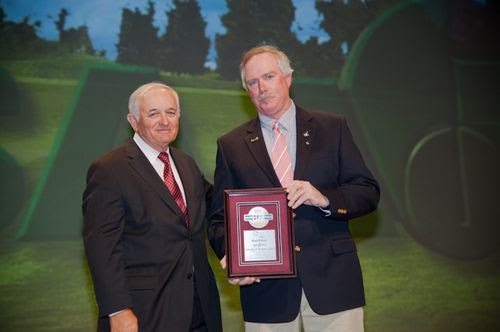
Tim Powers on the right; Superintendent at Crystal Springs GC in Hillsborough
National Award Winner for Environmental Stewardship
Congrats to my Friend and former Boss


The week started early Monday with an all day seminar titled Reducing Chemical Use on Golf Course Turf. Professors Frank Rossi and Jennifer Grant from Cornell University put on a very educational and entertaining seminar with much of their talk focused on alleviating the amount of stress that our turf encounters at different times of the year thus reducing the need to treat chemically. I'm all for the reducing the amount of chemical use on our course and intend to seek out any methods that will help us do so.

A Plan Based Budget Will Help You Succeed was the title of my class on day 2. Full of much needed info and advise especially for the greenhorn Superintendent, the best aspect of this seminar was continual discussion between the more than 60 Superintendents from all over the world.


Wednesday the doors of the Trade Show opened at 9am for all the Superintendents, Assistants and Course Owners and Builders to look at the many new products and equipment available. The trade show floor is massive and it's quite difficult to take in everything in just a day. Much time was spent re-connecting with industry friends and networking with other Superintendents and we ended up walking the floor all day Wednesday and half of Thursday.

Thursday morning was the highlight of the show for me. The GCSAA hosted a general session for all attendees and the keynote speaker was none other then David Feherty. Click the link below for a short interview and highlight clip from his time with the GCSAA. Beware, the language is colorful to say the least.  In listening to Feherty for over an hour, we all came away having laughed, cried and feeling very lucky to be American.


I will say that I'm very happy to be back home. It's always nice to come back to California and back to Claremont and I intend to apply the many lessons learned in our department. We Superintendents are truly fortunate to be part of such a special profession and I want to thank the membership at Claremont for their continued support. I leave you with this: "What They Think I DO" as a Golf Course Superintendent.

Thanks to Brian Boyer, Superintendent at Cinnabar Hills for turning me on to this. So funny and so True!!
Thanks and we'll see you on the golf course....